Scope
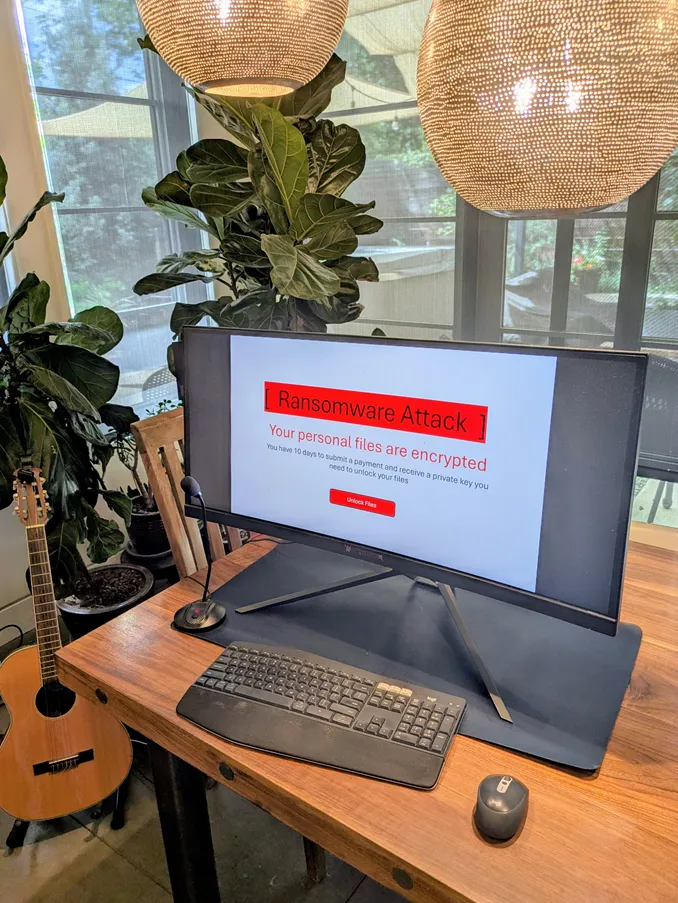
Ransomware is the cyber incident most likely to actually terminate a organization rather than merely disrupt it. Ransomware halts operations on the day it executes: point-of-sale systems stop, patient and client records become unreadable, payroll cannot run, and the phones may stop working.
This article covers how current ransomware operations function, the four access paths that account for most small-business incidents, the factors that determine recovery outcome, and the actions required in the first twenty-four hours.
How Modern Ransomware Operations Function
The prevailing model no longer resembles a lone operator distributing malware. Contemporary ransomware is an industry with specialized roles, and understanding that structure explains why small organizations are targeted.
- Ransomware-as-a-service (RaaS). Development groups build and maintain the encryption software, leak infrastructure, and negotiation portals, then license these to affiliates who conduct the intrusions and share the proceeds. The technical capability required of the affiliate is therefore low.
- Initial access brokers. A separate market sells validated access to compromised networks. An organization may be breached weeks before any ransomware is deployed, because the party that obtained access is not the party that will encrypt the systems.
- Double extortion. Data is copied out before encryption begins. The organization is then subject to two demands: payment for a decryption key, and payment to prevent publication of the stolen data. This structure is the reason backups alone no longer resolve an incident—restoring systems addresses availability but does not retract exfiltrated records. See data exfiltration for how that removal typically occurs.
Small organizations are selected because they hold data of real value, operate with limited detection capability, frequently lack tested backups, and reach a payment decision quickly. Affiliates working on commission optimize for probability of payment, not size of target.
Four Access Paths
Most small-business ransomware incidents originate in one of four ways. Each is addressable.
- Credential compromise. Credentials are obtained through phishing, voice pretexting, or reuse of passwords exposed in unrelated breaches, then used to authenticate to email, VPN, or remote access. Related coverage: vishing and password reuse.
- Exposed remote access. Remote Desktop Protocol and remote management services published directly to the internet remain among the most frequently exploited entry points. Any service reachable from the public internet without an authentication gateway should be treated as a live exposure.
- Unpatched perimeter devices. Firewalls, VPN appliances, and file transfer products are attacked within days of vulnerability disclosure because they are internet-facing by design and are frequently excluded from routine patch cycles. See patch management strategy.
- Vendor and managed service provider compromise. An attacker who compromises a provider inherits access to every client that provider administers. The CodeRED incident demonstrated the operational consequences for municipalities; see also vendor risk management.
Between initial access and encryption, attackers typically spend time enumerating the network, escalating privileges, identifying backup systems, and staging data for removal. Backup infrastructure is a priority target precisely because its destruction removes the alternative to payment. That interval is the defender's opportunity, and detecting it requires that someone is monitoring.
The Payment Decision
Organizations that have not considered this question in advance decide it under duress, with systems down and revenue stopped. The following factors are material and should be evaluated before an incident occurs.
- Payment does not reliably restore operations. Decryption utilities supplied by attackers are frequently slow, incomplete, or defective. Recovery from a decryptor commonly takes longer than restoration from functioning backups, and some data is typically unrecoverable.
- Payment does not retract exfiltrated data. The organization receives an assurance of deletion and no means of verifying it. Data has been published following payment.
- Payment may carry legal exposure. U.S. Treasury guidance has advised that facilitating payment to sanctioned entities can itself constitute a violation. Counsel should be engaged before any payment is authorized.
- Insurance terms govern the decision. Most policies require notification before payment and may deny claims where required controls were absent. Verify what your policy obligates you to do, and whether it was ever conditioned on controls you have since stopped maintaining. See cyber insurance providers.
Free decryption tools exist for a number of ransomware families through the No More Ransom project. Identifying the variant before considering payment is a required first step.
Controls That Determine the Outcome
The distinction between an organization that recovers in days and one that does not recover is established before the incident, and rests primarily on the following controls.
- Backups that are offline or immutable, and tested. This is the single determining control. A backup reachable with production administrative credentials will be encrypted alongside everything else. Maintain at least one copy that is offline, air-gapped, or write-protected against deletion, and perform an actual restoration test—an untested backup is an assumption. Record how long a full restore takes, because that figure is your outage duration.
- Phishing-resistant multi-factor authentication on all remote access. Applied to email, VPN, remote desktop, and administrative consoles, with no exemptions for owners or executives.
- No remote access published directly to the internet. Place remote services behind a VPN or zero-trust gateway. Audit what is currently exposed; the results are frequently unexpected.
- Restricted administrative privileges. Routine work should not be performed from accounts that can disable security tooling or delete backups. See access control.
- Prompt patching of internet-facing systems. Perimeter devices warrant a shorter remediation window than workstations.
- Network segmentation. Segmentation limits how far an intrusion propagates. Separating finance and operational systems from general workstation traffic is achievable in small environments.
- Endpoint detection with someone assigned to respond. Detection tooling that generates alerts nobody reviews provides forensic value after the fact and no preventive value. If no internal capacity exists, this is a defensible reason to engage a managed service provider.
Preparation Required Before an Incident
Several items cannot be assembled while systems are unavailable, and should exist in printed or offline form.
- An incident response plan identifying decision authority, notification obligations, and escalation sequence.
- Defined response team roles, including who authorizes disconnection of production systems.
- An offline contact list: insurance carrier, legal counsel, IT provider, bank, and principal customers. Contacts stored only in an encrypted system are unavailable when required.
- Documented recovery objectives per system, established through critical business function analysis. Determine which systems must be restored first before the decision is made under pressure.
- One tabletop exercise. Convening the relevant parties for ninety minutes to work through a hypothetical encryption event reliably surfaces gaps that documentation review does not.
First Twenty-Four Hours
If encryption is discovered in progress, sequence matters.
- Isolate rather than power down. Disconnect affected systems from the network, but do not shut them off—volatile memory may contain encryption keys and forensic evidence lost on shutdown.
- Protect the backups first. Physically disconnect backup media and revoke backup system credentials before any other remediation. Attackers frequently target backups after being detected.
- Notify your insurance carrier before taking remediation action. Policies commonly require use of approved response vendors, and independent action can void coverage.
- Engage legal counsel early. Breach notification obligations vary by state, sector, and data type, and the timelines are short. See data breach response and compliance.
- Report to law enforcement. Submit to the FBI Internet Crime Complaint Center and, where applicable, CISA. Reporting occasionally yields a decryption key and is frequently a condition of insurance coverage.
- Preserve evidence. Retain the ransom note, sample encrypted files, and system logs. Variant identification depends on these artifacts.
- Do not authorize payment on the first day. No decision made in the initial hours improves with haste, and the alternatives are not yet understood.
Summary
Ransomware outcomes are determined by preparation rather than by response quality. An organization with tested offline backups, multi-factor authentication on remote access, and a printed contact list experiences an expensive week. An organization without them faces a decision between paying an adversary and reconstructing the business from records that no longer exist.
The controls above require decisions and time rather than significant expenditure. The CSFSafe Cybersecurity Playbook provides the structured process for implementing them—including asset inventory, risk analysis, recovery objectives, and incident response planning—without requiring dedicated security staff. The free Cybersecurity Checkup identifies current standing on these controls.
References
- StopRansomware.gov — CISA, FBI, NSA, and MS-ISAC joint resource hub, including the #StopRansomware Guide
- No More Ransom — Europol-supported project providing free decryption tools and variant identification
- FBI Internet Crime Complaint Center (IC3) — incident reporting
- Multi-State Information Sharing and Analysis Center (MS-ISAC) — no-cost services for U.S. state, local, tribal, and territorial government
- Data Breach Investigations Report — Verizon, annual analysis of incident patterns and access vectors
- NIST IR 8374, Ransomware Risk Management: A Cybersecurity Framework Profile — National Institute of Standards and Technology
- Wiper Attacks: When the Goal Is Destruction, Not Ransom — CSFSafe
- Incident Response Plans: Why Every Organization Needs One — CSFSafe
- Business Continuity, Disaster Recovery, and Incident Response Teams — CSFSafe