
Scope
In October 2026, online retailer Asos revealed that an attacker had compromised an employee's login credentials by impersonating a trusted contact. The attacker exploited normal working relationships through increasingly convincing requests—a scenario playing out at thousands of organizations every day.
Employees are on the frontline of cybersecurity. They interact with attackers impersonating trusted colleagues, navigate sophisticated phishing attempts that bypass traditional red flags, and make split-second decisions about whether to click, respond, or report. Yet many organizations treat cybersecurity compliance as an IT problem—a single annual training course that employees complete and forget.
This article covers HR's critical role in building compliance through role-specific training, creating a supportive reporting culture, aligning leadership behavior, and moving from punishment to prevention. The goal is not perfect employees, but a workforce that recognizes threats, reports incidents without fear, and follows policies because they understand why security matters.
Why Employees Are the Target
38% of UK businesses experienced phishing attacks in the past 12 months. These aren't random attempts—attackers specifically target employees because they exploit trust, urgency, and the normal patterns of work communication.
The Asos incident is instructive: the attacker didn't hack a firewall or exploit a zero-day vulnerability. They impersonated a trusted contact and asked an employee for credentials. This is social engineering, not sophisticated technology. And it works because employees don't expect colleagues to be malicious.
Attackers are also getting smarter. AI-generated threats now bypass old red flags like checking for poor grammar. Sophisticated requests mimic how real vendors and colleagues actually communicate. The barrier between a legitimate request and a malicious one has become razor-thin.
Yet knowing about cyber threats doesn't automatically change behavior. Knowledge alone is not enough. Employees need to understand the real-world context, practice responding to threats, and trust that reporting suspicious activity won't get them in trouble.
Building Compliance Through Role-Specific Training
Annual cybersecurity training is a box-check exercise. One-size-fits-all training doesn't work because different roles face different threats. Finance staff need to know how wire transfer fraud works. HR staff need to recognize requests for employee data. Executive assistants need to identify calendar-invite phishing.
HR should tailor training to the specific risks employees actually face. This means:
Identify Role-Specific Threats
Finance teams: payment fraud, wire transfer requests, invoice manipulation. HR teams: employee data requests, benefits fraud, I-9 verification scams. Operations teams: supplier impersonation, procurement fraud. Executives: CEO fraud, wire transfer requests, confidential information theft.
Focus on Behavioral Change, Not Course Completion
Tracking training completion rates is meaningless. Employees can click through a course in 15 minutes and retain nothing. Instead, measure whether employees' actual behavior changes: Do they verify unusual requests through multiple channels? Do they report suspicious emails? Do they question unexpected access requests?
Embed Security in Daily Practices
Cybersecurity should not be an annual event. It should be part of how teams work every day. HR should work with IT to integrate security into workflows, policies, and processes. Make it easy to follow secure practices, not a burden that tempts people to bypass controls.
Use Simulations to Build Confidence, Not Fear
Phishing simulations should be training exercises, not punishment. Employees who fall for a simulation should receive immediate education on what they missed, not a disciplinary note. The goal is confidence in recognizing and reporting threats, not shame and hiding mistakes.
Simple Policies Beat Complicated Ones
Complex, inconvenient policies are universally bypassed. If a security control requires five approvals and takes two hours, employees will find a workaround. If a policy is confusing, employees will guess at the right behavior and frequently get it wrong.
Instead, HR and IT should collaborate to create policies that are:
Clear and Practical
"Verify unexpected requests by using multiple platforms to confirm who you're dealing with" is actionable. "Follow the cybersecurity policy" is not. Policies should tell employees what to do and why, in language they understand.
Aligned with Actual Work
If a policy makes it impossible to do the job, it will be violated. HR should work with department leaders to understand real workflows and design policies that protect without creating friction.
Consistently Reinforced
Leadership matters. If senior employees openly disregard security policies or complain they're inconvenient, junior staff will do the same. If executives bypass approval processes, they send a message that security doesn't really matter.
Creating a Culture of Reporting, Not Punishment
The biggest barrier to compliance is fear. When employees are afraid to report security incidents or mistakes, they hide the problem instead of escalating it. A breach that goes unreported for hours spreads exponentially. One that's reported immediately can be contained.
Most breaches come from human error, not malice. An employee clicking a malicious link is not the enemy. An employee hiding that mistake because they fear discipline is the real problem.
Differentiate Between Mistakes and Misconduct
An employee who clicks a phishing link but immediately reports it deserves support, not punishment. An employee who deliberately shares credentials or ignores security procedures for convenience needs accountability. HR should distinguish between the two and respond accordingly.
Investigate Root Causes
When a security incident occurs, dig deeper than "the employee made a mistake." Was the workload so high that they were rushing? Were instructions unclear? Was the legitimate request so similar to the malicious one that confusion was understandable? Was the employee under time pressure that forced them to skip verification steps?
Address the systemic issues, not just the individual behavior. If multiple employees make the same mistake, the problem is likely with the process, not the people.
Make Reporting Safe
Employees should feel empowered to report suspicious emails, unexpected requests, and mistakes without fear of retaliation. HR should communicate that reporting a mistake is the correct action, even if the mistake is costly. An unreported breach is always worse than a reported one.
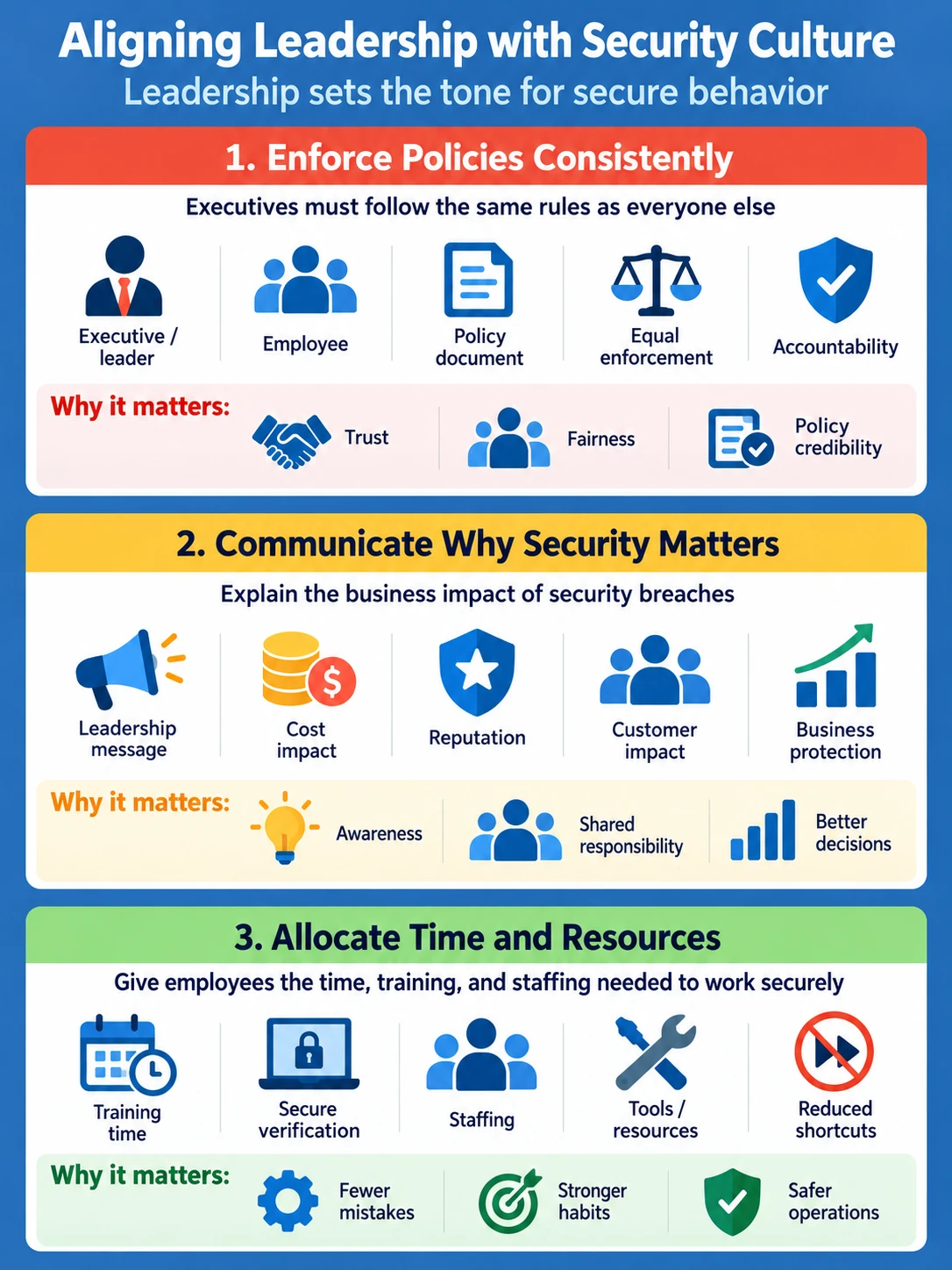
Aligning Leadership with Security Culture
Policies are most effective when leadership visibly follows them. If the CEO bypasses approval processes, publishes their calendar publicly, or uses weak passwords, the message is clear: security doesn't apply to everyone equally, and it's not really that important.
HR should work with leadership to model secure behavior and hold senior employees accountable for the same standards as everyone else. This means:
Enforce Policies Consistently
If an executive disregards a security policy, that should trigger the same response as if any employee violated it. Inconsistent enforcement destroys trust in the policy itself.
Communicate Why Security Matters
Leadership should regularly communicate the business impact of security breaches: the cost, the reputational damage, the customer impact. When employees understand that security directly protects their jobs and their customers, they're more likely to prioritize it.
Allocate Time and Resources
If employees are too busy to attend training, too rushed to verify requests, or under pressure to skip security steps, they will cut corners. HR should advocate for sufficient time and staffing to allow secure behavior.
Implementing HR-Driven Compliance
Cybersecurity is no longer purely an IT function. HR plays a critical role in shaping behavior, culture, and compliance. Here's how to get started:
Week 1: Map the Threat Landscape by Role
Work with IT to identify the specific cyber threats each department faces. Create a threat matrix: Finance (wire fraud, invoice scams), HR (data breaches, I-9 fraud), Operations (vendor impersonation), Executives (CEO fraud, data theft).
Week 2-3: Redesign Training Around Threats and Behavior
Scrap annual, one-size-fits-all training. Create role-specific modules that address actual threats and practice responding to them. Use simulations as learning tools, not gotchas. Measure behavior change, not course completion.
Week 3-4: Simplify and Communicate Policies
Review security policies with department leaders. Eliminate policies that are too complex, unclear, or misaligned with actual work. Ensure policies are simple enough that employees can follow them without workarounds.
Month 2: Build a Reporting Culture
Launch a communication campaign about the importance of reporting security incidents. Make it clear that reporting a mistake is the right action, not a cause for discipline. Create easy reporting channels (email, form, hotline).
Month 2-3: Align Leadership Behavior
Work with executives to model secure behavior. Ensure leadership follows the same policies as everyone else. Communicate why security matters to the business.
Ongoing: Monitor and Adjust
Track compliance metrics (reporting rates, phishing simulation performance, policy adherence) and adjust training and policies based on what you learn. Use incidents as learning opportunities, not just punishment events.
The Business Case for HR-Driven Security
Organizations with strong security cultures—where employees report threats without fear, follow policies because they understand why, and feel supported rather than monitored—experience fewer breaches and recover faster from incidents.
This is not HR spending time on IT's problems. This is HR doing its core job: shaping organizational culture, managing risk through people, and building trust between leadership and employees.
Cybersecurity compliance is ultimately a human problem, not a technology problem. And human problems are exactly what HR is trained to solve.